
Introduction
When speaking of how he and other geniuses deal with the extraordinarily complex concepts behind 'Quantum Theory Physics,' the renowned John von Neumann once said "You never really understand a theory, one just gets used to it." Welcome to the World of Music Theory.
The science of music is based on the fact that over the years our culture has (through simple appreciation) promoted music composed in a manner that demonstrates a natural purity definable in terms of mathematics. Tone and timber are simply part of nature. To put it more simply, it doesn't take much study to realize what sounds good to our ears musically is so naturally expressed in a scientific manner that it hardly seems a coincidence. Sadly, though theory can be a musician's greatest asset, studying the 'science' of music often seems to displace the 'art' of music.
While the Chord Wheel is not meant to replace textbooks dedicated to music theory, it will provide you the immediate access to the practical benefits of such knowledge which would otherwise require extensive study. The following is meant as a quick reference guide only. If you are unfamiliar with these most basic terms and concepts, refer to any of the innumerable sources of music theory study. If you are already quite familiar with music and chord theory, you may want to skip to the Chord Wheel Instructions section of this document and/or refer to the instructions printed on the back of the Chord Wheel.
Chord Progression
At the foundation of a composition is the chord progression which literally defines it. The song's melody and any improvisation played throughout are intimately tied to the underlying progression. Through the years a system has been developed to analyze and communicate between musicians what each listener experiences when listening to a progression.
The ability to analyze any given progression in terms of music theory is an absolutely essential skill for every musician. Without this skill, it's practically impossible to improvise/solo over, transpose or at times even communicate a given progression clearly. Yet due to its inherent complexity (and perhaps the complexity of most music theory textbooks), it's amazing how little understanding the typical musician possesses in this regard. Fortunately for you and especially for your music, you've found the Chord Wheel which will soon take you to another level of chord theory comprehension in no time.
Scales
Most study of music theory begins with scales. With a little research, you'll discover that scales will often be explained in terms of notation (the lines and dots), 'whole-step/half-step' patterns (which refer to the distance between notes in the scale) or a combination of the two. Unfortunately both methods are rather complex and usually result in confusion. Let's avoid this frustration by taking a step back and looking at scales simply in terms of how chords are constructed.
As you may know, a scale is simply a set of notes (usually seven) that take you from a given note through a series of other notes until it reaches the same note again an octave higher. Though the initial note is much lower in tone than the finishing note, the way our ears hear music they sound almost identical. (Think of the two "Do's" in "Do, Re, Mi, Fa, So, La, Ti, Do.") This pattern repeats over and over, up and down. This circular behavior is common in music theory and is a principal reason the Chord Wheel is constructed the way it is.
Constructing Chords from Scales
The most fundamental scale is the Major Scale. (The "Do, Re, Mi, etc." example we referred to earlier is the Major Scale.) Instead of concentrating on how the scale is devised, let's focus on how chords are constructed from a scale. A 'C Major Scale' starts from a C note and climbs through seven of the eleven notes in-between until it reaches the C an octave higher. By assigning numbers starting with the first note and moving upwards counting, we reach the octave C where it would be counted '8' (or another '1' if we consider it to be starting over).
The most basic chord is called a triad as it contains three notes. Triads are put together by first taking any note in a scale as a starting point (called the root of the chord). From the root we skip a note in the scale and add the next note instead. So if we were starting from the first note in the C Major Scale (which, of course, is a C and we earlier numbered as '1') we would add the note numbered '3.' By once again skipping a note (the one we numbered '4') and adding the '5' note we have three notes and our first chord!
Our three notes, the '1, 3 & 5' notes of the scale provide us with the first chord of the Family of Chords for the C Major Scale. By constructing chords from each note in the scale (using the 'every other note' pattern) we come up with seven basic triads (i.e. three note chords). Whenever we use the C Major Scale and the chords we have derived from it, we are said to be working in the 'Key of C.'
Confused yet? If you are, fear not! Just read on, follow along and read it again later on. Like any good theory, it just takes getting used to. The beauty of actually using the Chord Wheel is that much of this knowledge will be just handed to you. However, it's important to have access to the actual theory behind what the Chord Wheel will make so easy for you to practice.
The Major Scale
So what are the notes of a given Major Scale? With the Chord Wheel the answer is right at your fingertips. But first, let's make sure we know our Roman Numerals. Why Roman Numerals? While the reasons may become apparent later, for now let's just say we use Roman Numerals because that's what musicians do.
| Number | 1 | 2 | 3 | 4 | 5 | 6 | 7 |
|---|---|---|---|---|---|---|---|
| Roman Numeral | I | II | III | IV | V | VI | VII |
| roman numeral | i | ii | iii | iv | v | vi | vii |
*Note that Roman Numerals can be capitals or lower-case
Grab your Chord Wheel and align the movable transparent disc in such a manner as the small arrow above the box labeled 'KEY - I chord' is pointing to the 'C' at the top center of the inner circle and colored light yellow. Once properly aligned, you have at your fingertips the key of 'C.' Within the triangular outline, you'll notice seven boxes that is also depicted in the black-and-white legend at the upper right of the wheel. At the base of each box printed on the clear disk you'll notice a Roman Numeral followed by the word 'CHORD.' Using just the Roman Numerals for the time being (pay no attention to whether they are capitals or lower-case and for now ignore any lower-case 'm'), we can read off the notes in the C Major Scale as shown below:
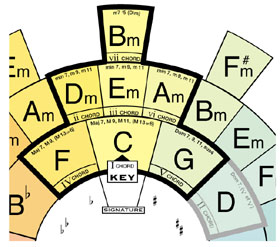
Notes of the C Major Scale:
| Key | I | ii | iii | IV | V | vi | vii |
|---|---|---|---|---|---|---|---|
| C | C | D | E | F | G | A | B |
Notes of the G Major Scale:
| Key | I | ii | iii | IV | V | vi | vii |
|---|---|---|---|---|---|---|---|
| G | G | A | B | C | D | E | F# |

If this seems like a lot of work to determine the notes in a scale, don't worry. First of all it's not a question you'll need to be asking yourself frequently in terms of exercising the practical benefits of chord theory. Also, you'll become much more familiar with the layout of the Chord Wheel as you begin to appreciate its unique advantages. This is all just background information.
Root Progressions
The chords to a given composition are often expressed in term of a Root Progression. (i.e. The Roman Numerals.) At first terms such as 'Imaj9' or 'vim7' will seem complex. As you will see they really aren't and expressing songs in terms of Root Progression is extremely valuable for analyzing, communicating and transposing progressions. Let's start with the 'I Chord.'
The 'I Chord'
We've already determined the notes of the first chord in the Key of C contain the 1st, 3rd and 5th notes (or I, iii and V in Roman Numerals) in the C Major Scale; thus the notes of this chord are C, E and G. This chord is called a C Major (though it's often referred to just as a 'C' as one takes the 'Major' for granted). As it's built from the first note of the scale this chord is also referred to as the 'I Chord' (pronounced "One Chord" as it's a numeral not a letter). Because 'I Chords' are so fundamental to the sound of any given key, musicians have given it yet another special name: the tonic! You'll learn more about its sound and uses later in this document.
The 'ii Chord'
Using our pattern of adding every other note from a note in a scale to form chords, starting with the second note in a scale gives us a 'Two Chord.' From our pattern we know that it will contain the 2nd, 4th and 6th notes of the Major Scale in a given key. Collecting the notes from the 'ii, IV and vi' designations (the numerals for 2, 4 and 6) on the Chord Wheel it can be determined that the notes of a basic 'ii Chord' in the 'Key of C' are D, F and A.
Next let's look at the differences between Majors and minors.
Majors vs minors
Now it's time to talk about the difference between the Roman Numerals in capital letters (I, IV and V) and the Roman Numerals in lower-case letters (ii, iii, vi and vii). It's also related to the lower-case 'm' after many of the notes/chords printed on the Chord Wheel. Upper-case numerals and lack of an 'm' following a chord's name designate it as a 'Major Chord' (such as the C Major or 'I Chord'). Lower-case letters and Chord Names whose root letter is followed by a 'm' are Minor Chords.
In this manner, you can tell right away that a 'ii Chord' is going to be a 'Minor Chord' because the Roman Numeral used to express it is lower-case. When aligned to the 'Key of C,' the 'ii Chord' outlined by the pattern on the transparent disk of the Chord Wheel reads 'Dm.' This is spoken as 'D Minor.'
You may well ask "What's the difference between a Major and a Minor chord?" While this is essential knowledge, it will momentarily take us back into the more traditional concepts behind music/chord theory. If it starts to sound confusing (and it will), as always - don't sweat it. You'll get used to it. We'll start out defining Majors and Minors in regard to how we see them with using the Chord Wheel. Then let's take the more traditional approach and in this manner you'll see the object from two angles.
Start out with the tonic chord (i.e. 'I Chord') of the 'Key of C,' which you now know to be a C Major built from the 1st, 3rd and 5th notes of the C Major Scale. The actual notes are C, E and G. The Chord Wheel tells us that the chord is a major but doesn't tell us why (just as it tells us the 'ii Chord' is a minor without explanation).
Using the Chord Wheel, determine the 'ii Chord' in the Key of Bb (pronounced 'B flat') and what are the notes it uses? After you spin the transparent disk until the 'Key – I Chord' box's arrow is pointing to 'Bb' you'll notice that the 'ii Chord' is a 'Cm' or C Minor. Now starting at ii (or 2) and taking every other note (adding the 'IV ' and 'vi' or in numbers the 4th and 6th), you can see the C Minor chord is made up of the notes C, Eb ('E flat') and G.
(Another great way to do this is always knowing that the 'every other note' pattern is going to provide a note with an 'every other' letter. So in this case, starting with C, we know the next two notes will be E and G because they are 'every other' letter after E. When you go past G just start over again at A. The only thing left is to figure out if they happen to be sharps (#'s) or flats (b's) in their name and the Chord Wheel can help you with that!)
Now, back to the Major/Minor discussion. So if a C Major is made up of the notes C,E and G while a C Minor is made up of a C, Eb and G, what is the difference? The second of the Minor chord's three notes is an Eb while the Major is an E. Thus the difference is this middle note is flatted. The E and Eb are a different note by one degree on any musical instrument, whether it be one piano key or one fret of a guitar. This difference is the smallest measurement used in music utilized by western culture and is referred to as a 'half-step.'
Chord Degrees
As promised, we are now going to take a step back into the traditional method of chord theory education. In the opinion of many, traditional music theory is unnecessarily complex. If you feel yourself getting lost, don't become frustrated. Understanding the traditional concepts is a must in terms of communicating with other musicians and digesting other sources of theory education. The more used to it you become, the more its peculiarities will make sense.
Numbering the notes in a chord 1st, 3rd and 5th was not something I had you do by accident. Traditional music theory refers to these as chord degrees. So a basic chord (a chord with just three notes) consists of the 1st degree (the root), the 3rd degree (which determines whether a chord is major or minor) and the 5th degree (which simply 'beefs up' the root, unless it's altered).
Taking a C Major Scale's 1st, 3rd and 5th degrees provides us with a C Major chord. In traditional music theory education, you would be told to 'flat the 3rd' degree to get a C Minor. (C, E and G then become C, Eb and G; Major to Minor.) When working within chord theory, you can see that rarely would you want to describe a C Minor chord (which we've seen is the 'ii Minor' chord in the Key of Bb) in terms of how it relates to the Key of C where we now know that the C would be played as a major (and is the tonic!). If this doesn't make sense, well..., that's the point.
To make matters a little more confusing for you, instead of describing the 'ii Minor' chord in terms of 2nd, 4th and 6th notes of the root's Major Scale, traditional theory requires us to rename the degrees as 1st, 3rd and 5th and correlate back in terms how the degrees would relate to the 'ii Minor's' root note if we looked at it with its own major scale (even though it's a minor and we're using it in an entirely different key). So the C minor would become 1st, flat 3rd and 5th in the C Major scale. Thus the formula for a 'Minor Chord' is 1st, flat 3rd and 5th.
Let's get back to the more straightforward concepts behind the Chord Wheel so that instead of being confused by the smoke and magic behind music theory, you can start using it to make music.
The Seventh Chord
In addition to helping you understand how music theory has always been taught, another advantage to our sidetrack into the confusing world of traditional theory education is that now you'll understand why 'Seventh Chords' are called such. If a basic chord contains three notes of a scale, what happens when we add a fourth note? From the tonic we would now have the 1st, 3rd, 5th and 7th notes of the scale. Thus the fourth note makes the chord a 7th chord. Make sense? If it doesn't just get used to it; adding the next note in our 'every other' pattern makes the chord a seventh chord.
The 7th Chord
There are three basic types of 7th chords. As you may have guessed, like the Major/Minor nonsense they are named with consideration of how far apart the four notes are in relation to the root's Major Scale even if we are dealing with a Minor Chord . So let's forget about that for now (plenty of books out there about this if you're curious) and focus on how they function in regards to the practical benefits of chord theory.
The three basic types of 7th chords are: Major 7th, Dominant 7th and Minor 7th. The first two are built from adding the fourth note to a major triad (a fancy name for our three note major chord) and the last is built from a minor triad. The difference between the Major 7th and Dominant 7th is also 'a half-step' but as in our earlier discussion, it's how they sound and are used that's important.
So when writing or playing a song in the Key of C (follow along with your Chord Wheel), you can see that we can play a C Major, F Major and G Major as a progression and expect it to sound solidly 'In Key.' The results in fact sound very good; as if the chords belonged together. In fact, if you analyze the C, F and G progression above with your Chord Wheel you would find that it translates as the 'I Chord' followed by the 'IV Chord' followed by the 'V Chord.' Ever hear somebody mention a "One, Four, Five Progression?" What they were really saying was 'I, IV, V.' It's simply the most common chords used in progressions ever. (It's often referred to as the 'Blues Changes' and are basically the only chords used in the renowned 'Twelve Bar Blues.' Though later you'll see how it can be spiced up.)
Suppose we wanted to play the chords as 7th chords to add more flavor. If our intent was to keep the song completely and perfectly within the Key of C (called 'Diatonic'), the Chord Wheel prompts us with the appropriate type of 7th. Printed on the transparent disk and centered just above the Chord Wheel's note/chord names you'll see Maj 7 (Major 7th) above the C and F, while Dom 7 (Dominant 7th) is centered above the G. This lets you know that modifying the progression to be played C Major 7th, F Major 7th followed by G Dominant 7th would yield the desired results. Abbreviations for the three chords would look like this: CM7, FM7 and G7. Note that a chord that simply shows '7' is a Dominant 7th chord. Both Major 7 and Minor 7 chords require their abbreviations. Such as CM7 and Dm7 where the lower-case 'm' lets you know it's a minor.
Keys / Family of Chords
Keys have been settled upon because the seven basic chords formed from the Major Scale 'sound good or like they belong together.' Consider these the key's 'Family of Chords.' For now, it's not essential to understand any more of exactly how they are formed, so if the above sounds complex just ignore it for now. Each of these chords have simply been assigned a Roman Numeral based on what the root (i.e. starting point or lowest note) of the chord is.
In this manner, the standard blues progression referred to earlier (the 'one, four, five' progression) is expressed as 'I - IV - V.' Thus we can see a typical blues progression in the key of D would consist of playing D, G and A chords (the I, IV and V chords of the key). Likewise, a common jazz progression is the 'ii-V-I Cadence.' Though it sounds complex, a ii-V-I in the key of C is simply Dmin, G then C.
Prior to the advent of the Chord Wheel, extensive study and memorization was required to have this knowledge at your fingertips. Even then, should a number of months go by without exercising the knowledge the information slips away (as many degreed musicians can attest). Look instead at the legend printed in black and white at the upper-right of the Chord Wheel as well as the corresponding outline printed on the clear disc of the Chord Wheel.
Notice that the inner most circle consists of a given key's 'Major' chords (the I, IV and V) while the middle and outer circle contain the key's 'Minor' chords (the ii, iii, vi and vii). Align the clear disc in such a manner as the small arrow above the box labeled 'KEY' (and 'I chord') is pointing to the 'C' at the top center of the inner circle and colored light yellow. Once properly aligned, you have at your fingertips the key of 'C.'
Now you can plainly see that the 'IV chord' in the key of C is F Major. Should you wish to add a fourth note in the chord (i.e. a 'seventh' degree), the Chord Wheel prompts you to use a F Major 7 chord in this case. In the same manner, note that the 'V chord' (pronounced 'five chord') in the key of C is a G Major or a G7. As we discovered earlier, a G7 is also called a 'G dominant 7' which is a Major chord utilizing a 'seventh' degree that is a half-step/one note flatter than a Major 7th chord. (Once again, if this sounds complex just ignore it.) You may often see the chord referred to as a 'V7.' We know it's a 'major' chord because there is no small 'm' (a musician's abbreviation for 'minor') after the G and because the corresponding Roman numeral 'V' is a capital and not a small case 'v.'
ii vs II and iii vs III
In the legend you may notice that the 'ii' and 'iii' chord have listed with them a 'II' and 'III.' This is an indication that you may notice songs that use major chords (II and III) when playing chords based on the 'second' and 'third' notes of the scale instead of the typical minor 'ii' and 'iii.' In the case of the key of C, this would be using D Major instead of a D minor ('II' instead of a 'ii') and using a E (Major) instead of a Em ('III' instead of a 'iii'). Try using your Chord Wheel to analyze the songs of Jimi Hendrix. You'll find he had quite a penchant for 'III chords' while Elton John and Bob Dylan uniformly stick to 'iii chords.' The Beatles on the other hand, loved to use 'II7 Chords' and even 'III7 Chords.' Refer to the 'Analyzing Compositional Styles' section.
Like many of the concepts behind the Chord Wheel, there is an infinitely more complex chord theory explanation behind this 'II' and 'III' substitution. It has to do with phrases like 'Secondary Dominants' and should you wish to further your comprehension of music theory via additional research, it will be explained in agonizing detail. However, the entire purpose of the Chord Wheel is to have you enjoying the essential, practical benefits of chord theory without exhaustive study.
On the Chord Wheel's clear disc, you'll see the 'II Chord' and the 'III Chord' are also outlined above their respective roots. Thus when in the key of C, the D is outlined just to the right of the G. This is an indication that D (or as it prompts you, a D7) will often be found in 'Key of C' progressions.
Key Signatures
Before we get into the practical applications of the Chord Wheel, you should also be familiar with 'Key Signatures.' Simply put, a Key Signature is a representation as to the number of notes in a given scale (and thus the roots of its related key) that are sharps or flats. Without getting too much into the theory behind it, each key has a number of notes in it which are 'sharped' or 'flatted' and this is always represented after the clef of any written musical score. While reading notation is not necessary to utilize chord theory, the Chord Wheel will supply you with Key Signature knowledge.
Turn the clear plastic disk on your Chord Wheel so that the 'KEY-I Chord' arrow is aligned with D (in green). When properly aligned, you'll notice that two of the chords in the key of D have sharps: the 'iii Chord' (F#m) and the 'vii Chord' (C#°). Because any given chord within a 'Key' is built from a note in a 'scale,' it can be said that the Key of D is the 'Key of Two Sharps' just as the 'D Major Scale' contains two sharps. (In fact, by using just the letter name of the chord, with the Chord Wheel you always have access to the notes in any major scale at your fingertips. In this regard, the D major scale can be read as: D, E, F#, G, A, B, C#. Just go from 'I, ii, iii, IV, V, vi, vii' in any key on the Chord Wheel.)
On the clear plastic disk, you will find a small box below the 'KEY' and above the word 'SIGNATURE.' In this box you can readily find the number of sharps or flats in any given key. Turn the disk until it rests on the key of C. The empty box indicates there are no sharps or flats and inspection of the chords outlined above confirm this. The key of E flat (Eb) however, contains three flats in its scale and thus in its family of chords as well as its key signature.
Analyzing Songs and Compositional Styles
Whether you're analyzing a given composition in preparing an improvisation or just to see what aspects of music theory your favorite tune uses that makes it 'click,' the Chord Wheel will prove worth its weight in gold. (And maybe Gold Records.) This section will walk you through analyzing any progression; though we'll use the compositions of The Beatles as a reference point as most people agree they were pretty decent songwriters.
The Chord Wheel will make analyzing even the most complex progressions a breeze. While many popular songs remain entirely in one key, it's not unusual for a song to modulate to any number of keys. This is especially true with jazz which frequently modulates in and out of various keys throughout a given composition. In more traditionally structured music, you'll often find key modulations at points in a tune that musically 'take the song somewhere else;' such as a chorus or a bridge.
If in the middle of a verse there appears a chord that sounds like it came out of left field, it's probably out of key (often referred to as accidentals though they are not accidents at all). It's important to remember that 'out of key' does not imply incorrectness. In fact, many amazing songs are memorable because of their use of less predictable chords. What's important is that you know where these chords are coming from so it can become part of your ever-expanding musical vocabulary.
Armed with this knowledge, you'll be able to more precisely control your melody lines, improvisations, chord substitutions and 'comping.' (The last term is derived from 'accompanying' and meaning to freely interpret a chord progression behind a soloist in such a way that you add variety without altering the tonality of the song which would confuse the soloist and listeners). Each of these essential skills will be more readily mastered with use of the Chord Wheel.
Let's use the Chord Wheel to analyze the compositional style of Lennon, McCartney and Harrison. It's much easier than it sounds and you'll immediately begin to realize your unique voice. We'll start with 'Let It Be.'
LET IT BE by The Beatles (Lennon/McCartney)
Analyzing LET IT BE
Turn the clear plastic disk until you find as many chords in the "Let It Be" progression contained within the triangular pattern (or also within the two lighter highlights just clockwise of the pattern) as possible. When you placed the disk where the lower-centered 'KEY-I Chord' box is aligned with the letter 'C' you were certain to notice that all of the verse and chorus chords are contained within the triangular pattern. Congratulations! You've just discovered that "Let It Be" can be said to be in the 'Key of C.'
Root Progression Analysis
Let's take our analysis of "Let It Be" a step farther by converting the song into a Root Progression format. Which means we are going to convert into the Roman Numerals. Ease of future transposing is just one of the benefits of this methodology.
With the Chord Wheel positioned with the 'Key' box centered upon the letter 'C' and examine the chords characteristic of the 'Key of C.' The first chord of the verse is 'C' which (as you see at the base of the 'C' outline on the Chord Wheel) is the 'I Chord.' Spoken as 'One Chord' because they're Roman numerals, not letters.
The first chord in the progression is "C;" the 'I Chord.' It is the defining chord of the key and is also called the tonic. It is consistently the most utilized chord regardless of key and most of the other chords in a key's 'family' will tend to make listener ears ache to hear the resolution provided by the 'I Chord.' Use this expectation to pull listeners along as well as providing them with the comfortable resolution they desire.
The second chord of the verse is 'G.' At the base of the clear plastic disk's outline of the G major chord you'll see the designation 'V Chord.' This 'Five Chord' is probably the second most important chord in a given key. Its sound is often said to have the strongest tendency to make the listener expect to hear the 'I Chord' especially when used as a Dominant 7th. Otherwise, like the 'I Chord,' this chord is also a Major chord when played as a triad (with only the first three basic notes).
The third chord, 'Am,' you'll discover functions as a 'vi Chord.' Take the time to determine the Roman Numeral for the rest of the chords in the song. Once you have completed this task you are ready to express 'Let It Be' in terms of chord theory.
LET IT BE by The Beatles (Key of C)
*Note: Chords are approximate and supplied for private study, scholarship and research.
Congratulations! You've just theoretically dissected one of the most popular tunes in music history. (Well, actually there's a bit more during the song's closing and you could get a lot deeper in depth, but the Chord Wheel is going to get you there.) So what's this useful for? Let's say you're welcoming a surprise vocalist on your next gig and they love the tune you've picked out, just in a different key! Or perhaps you'd like to compose catchy tunes. By only briefly analyzing your favorite composers you'll be amazed by what you learn about your ears and what you find pleasing in music. You're on your way to writing better music. The best avant garde artists who are always bending and breaking the rules, typically are well in control of just how, when and where they're breaking them. So let's get started.
Transposing With The Chord Wheel
Transposing "Let It Be"
By turning the transparent disk to another key, let's use Bb (most tenor saxophonists' favorite key), we can now translate the Roman Numerals into their respective chords for the selected key. If it sounds ridiculously easy, then you get the idea. Still let's go through it to stay on the same page.
The first half of the verse is I, V, vi and IV. With the 'KEY – I Chord' box's arrow centered upon the 'Bb,' you can read from the disk that the 'I Chord' is 'Bb' and the 'V Chord' is 'F.' In the same manner vi and IV are Gm and Eb respectively while the I, V, IV, I section is translated as Bb, F, Eb, Bb.
Analyzing "Let It Be" Further
What can be said about the compositional style of 'Let It Be' and its composer (some guy named McCartney)? The Verse begins with the 'I Major' (a safe place to start) and moves quickly to the 'V.' From there we move a little farther away from the tonic by heading to the 'vi' then back a little closer with the 'IV.' Now the second part of the verse begins with the identical 'I' to 'V' movement but instead of following the pattern set earlier, the song moves immediately to the 'IV' and finishes back on the 'I'.
Starting and finishing the second part of the verse with the 'I Chord' lends the song a strong sense of center and provides a perfect launching point for the chorus to take us somewhere else. The chorus's pair of initial minor chords (the 'vi' and 'iii') are less straightforward and common and provide the sense of space we were looking for and last couple of measures simply echo the closing of the verse and return to the song to where we began. Take special note of the back-to-back measures of the C chord as a transition between the two chorus parts. What else but the tonic begs for such a use?
A final note on 'Let It Be.' As you certainly realize, not every song written utilizes chords from but one key. Just don't become convinced that the more complex a song is the better it is. You'll be amazed how many enormously memorable songs are in a single key including practically the entire catalog of songwriting legends such as Bob Dylan, etc. When the chords of a song or notes of a chord fit perfectly into a single key, they are said to be diatonic. The more fancy words you memorize, the smarter you'll sound.